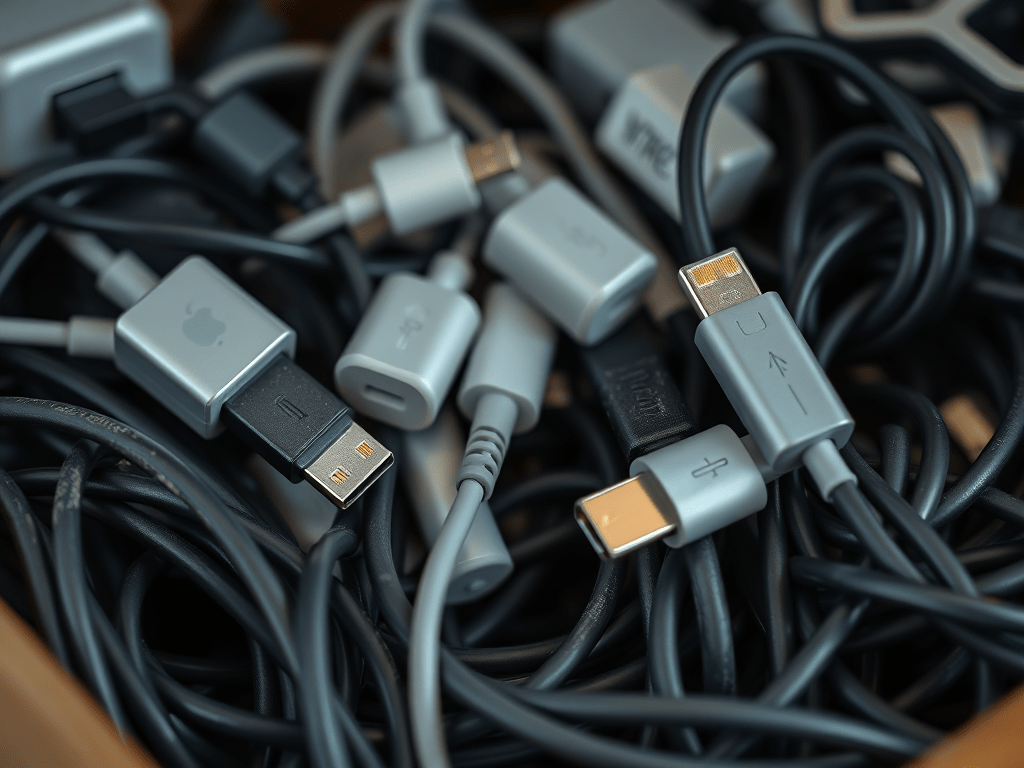


Unless you live under a rock, or in the Western Hemisphere, you’re probably aware of the new EU directive to commonize charging ports on electronic devices. It came into effect January 1st, 2025, though most manufactures like Apple and others have already complied. Here’s why it’s the dumbest law ever.
The Directive
In a nutshell, the directive had the following multi-faceted purpose:
- Increasing consumer convenience: You can charge your mobile phone and other similar electronic devices with one USB-C charger, regardless of the device brand.
- Reducing e-waste: Discarded and unused chargers account for about 11 000 tonnes of e-waste annually. The new rules encourage reusing chargers, which helps to reduce the environmental footprint.
- Saving money: You can now buy new electronic devices without a charger. This will help consumers save approximately €250 million a year on unnecessary charger purchases.
- Harmonising fast charging technology: New rules help to ensure that charging speed is the same when using any compatible charger for a device.
My New Phone
Sounds great, right? But here’s the issue. I’m an Apple guy, and I got my first iPhone 5, with the lightning connector, back in 2012. Since then all of my iPhone’s have had… lightning connectors. Until now. My new iPhone has a USB-C connector. Don’t get me wrong, I love the USB-C connector and standard, and this change was probably inevitable anyways. Regardless, even if you’re not an Apple person, your “device” of choice probably had some other common connector, most likely micro USB.
The Catch
I, and probably also you, have a drawer full of cables with a connector suitable for your device of choice. I also have one in my car, bedroom, kitchen, living room, office, garage, and who knows where else. They’re all now useless.
I now have to go out and buy all of those cables (with the new connector) again. The directive claims it will help me by “Increasing consumer convenience” and “Saving money“. I’m confused. How does having to replace all of those charging cables save me money? And how is it a convenience if I have to take the time to go out and re-purchase them all?
The directive also claims it helps by “Reducing e-waste“. I’m not sure this is true since I, and everyone else with now useless lightning or micro USB cables, will ultimately toss them in the trash (or recycle – which will get there anyways).
In my eyes, I see the opposite happening to what the directive intended. That is, a surge in the purchase of new charging cables by the majority of EU citizens (and everyone else buying a new device), and a surge in e-waste as we all get rid of the old ones.
What the EU should have done
If the EU was truly looking to save it’s citizens money and reduce e-waste, then it should have pushed for a freeze on existing device charging ports. In other words, Apple would have to stick to the lightning port for all future models, and the other manufactures with micro USB, or whatever they’re using. Sure, that stifles innovation, but the new directive does that anyways by forcing everyone to use USB-C.
This is just another example of a pointless regulation by politicians that ultimately transfers our hard-earned money to the Peoples Republic of China.


 Nick P
Leave a comment